
Why Does My Lower Back Hurt When I Sit All Day?

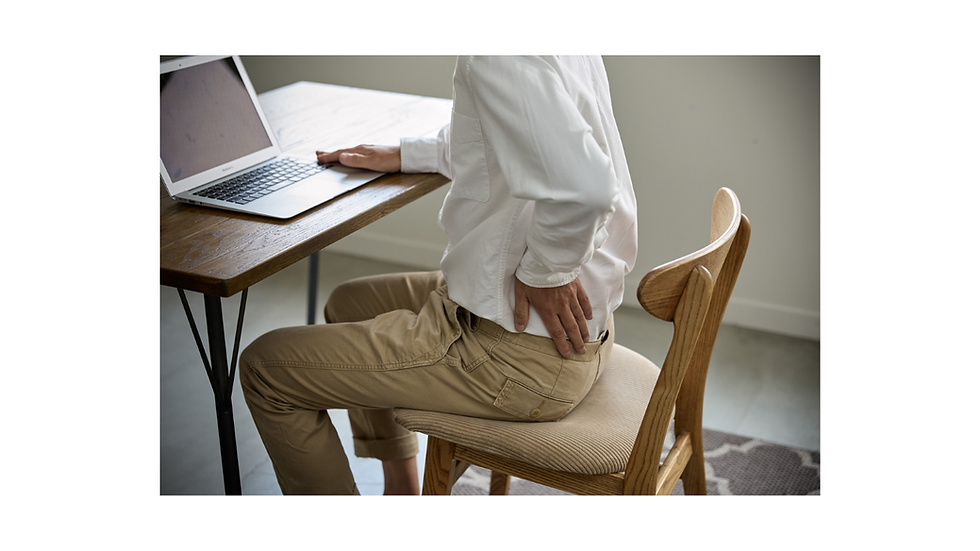
It usually starts with a dull ache that builds through the afternoon. By the end of the day, you're shifting in your chair, stretching at your desk, and counting down until you can get up and move. Sound familiar?
Lower back pain is the most common musculoskeletal complaint we see at Well By Design Chiropractic — and the majority of the time, a desk is somewhere in the story. The good news is that it's almost always something we can get on top of. But first, it helps to understand why sitting is so hard on your spine in the first place.
Why Sitting Puts So Much Pressure on Your Back
Most people assume that sitting is restful for the spine. It isn't. When you sit — especially in a slumped or forward-leaning position — the load on your lumbar discs increases significantly compared to standing. Over hours of desk work, that pressure adds up.
Add to that the loss of movement — your spinal joints and the muscles supporting your back need regular movement to stay nourished and functional — and you have the conditions for stiffness, muscle fatigue, and pain to develop fairly predictably.
Research suggests that lower back pain is one of the leading causes of work absenteeism in Australia, and desk workers are among the most affected groups. It's not a character flaw or a sign of weakness — it's a load management problem.
Common Causes We See in Desk Workers
Lower back pain in office workers rarely has a single cause. More often, it's a combination of:
Prolonged sitting in a position that places ongoing stress on the lumbar spine and discs
Tight hip flexors — when you sit for long periods, these muscles shorten, which pulls on the lower back
Weak core and glute muscles that are no longer doing their share of the work supporting your spine
A workstation that doesn't suit your body — chair height, screen position, and keyboard placement all matter
Reduced movement throughout the day — joints and muscles that don't move enough become stiff and irritable
Stress — which increases muscle tension, particularly through the lower back and shoulders
Sometimes there's also an underlying structural issue — a disc bulge, joint irritation, or early degenerative change — that sitting is aggravating. This is worth ruling out if your pain has been going on for a while or is getting worse.
How Do You Know When It's More Than Just Tightness?
General desk-related back ache tends to ease with movement and feel worse after long periods of sitting or first thing in the morning. That pattern is usually muscular or postural in origin and responds well to conservative care.
It's worth getting a proper assessment if you notice:
• Pain that travels into your buttock, thigh, or down your leg
• Numbness or tingling in your legs or feet
• Pain that is constant and doesn't change with position or movement
• Back pain that wakes you from sleep
• Pain that has been building for several weeks without improvement
⚠️ If you experience sudden loss of bladder or bowel control alongside back pain, seek emergency medical attention immediately. This is rare but requires urgent assessment.
What Actually Helps
1. Move more — even just a little
The research is consistent here: staying active is better for lower back pain than resting. You don't need to go to the gym. Simply breaking up long periods of sitting — standing up, taking a short walk, doing a few gentle movements every 30 to 40 minutes — makes a meaningful difference to how your spine copes with desk work.
2. Sort out your workstation
Small adjustments to your workspace can significantly reduce the load on your lower back. Your feet should be flat on the floor, your hips and knees roughly at 90 degrees, your screen at eye level, and your lower back lightly supported by your chair. If you're working from a laptop on a kitchen table, that setup is likely contributing to your pain.
3. Strengthen what's switched off
After months or years of sitting, the muscles that support your spine — your deep core, glutes, and hip stabilisers — tend to underperform. Targeted rehabilitation exercises that address these specific muscles are one of the most effective long-term strategies for back pain. This is something we assess and prescribe individually at our clinic.
4. Address what's stiff and restricted
Chiropractic care works on restoring movement to joints that have become stiff or restricted through prolonged sitting and inactivity. When joints move better, the surrounding muscles tend to relax, and pain decreases. Spinal manipulation, soft tissue work, and dry needling are tools we use depending on what your assessment shows.
Frequently Asked Questions
How long does lower back pain from sitting usually last?
For most people, postural lower back pain that's addressed early — with movement changes, ergonomic adjustments, and appropriate care — improves within a few weeks. Pain that's been present for months, or that has a structural component, may take longer but still responds well to the right approach.
Should I use heat or ice?
For most chronic or postural desk pain, heat is more helpful than ice. Heat relaxes the muscles, increases circulation, and helps ease the stiffness that builds up through a day of sitting. Ice is generally more useful for acute injuries — the kind where something went 'ping'.
Is it worth getting a standing desk?
Standing desks can help, but standing all day isn't the answer either. The real goal is variety — alternating between sitting and standing, and building in regular movement breaks. A standing desk paired with a good anti-fatigue mat and a commitment to moving regularly is a worthwhile investment for many desk workers.
Lower back pain that keeps coming back — or that's slowly getting worse — is telling you something. It's worth finding out what's actually driving it rather than just managing the symptoms day to day.
If desk-related back pain is affecting your day — whether it's a constant ache or occasional flare-ups — we'd love to help you get to the bottom of it. We're accepting new patients at our Balwyn North practice.
Book online at www.wellbydesignchiropractic.com.au or give us a call. Getting it assessed properly is always the right first step.


Comments